
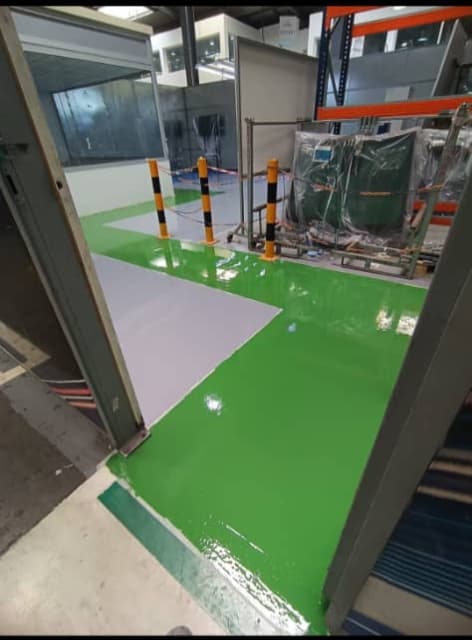
Industrial Epoxy Flooring in Abeokuta & Across Nigeria
An industrial floor takes more punishment than any other surface in a business. Forklift wheels, dropped tools, spilled oil, hot water washdowns and the constant grinding of pallet trucks will destroy bare concrete within a few years — and once concrete starts dusting, that dust ends up in your machinery, your product and your workers’ lungs.
ABA Eagle Enterprise installs heavy-duty industrial epoxy floor systems for factories, warehouses, workshops, food processing plants, aircraft hangars and store rooms in Abeokuta, throughout Ogun State and across Nigeria. We use 100% solids, solvent-free epoxy, which means the coating does not shrink back as it cures and you get the full film thickness you paid for.
Request a free quoteHow we install an industrial epoxy floor
Nearly every industrial floor failure traces back to preparation, not to the epoxy itself. A coating can only be as sound as the slab underneath it, so most of our time on site goes into the surface before any resin is mixed.
- Moisture and soundness testing — we check the slab for rising damp and for weak, laitance-covered concrete before quoting a system.
- Mechanical preparation — diamond grinding or shot blasting to open the concrete pores. We do not acid-etch; it leaves salts behind that cause peeling.
- Repairs — oil-contaminated patches are cut out, cracks and joints are filled with epoxy mortar, and low spots are levelled.
- Priming — a penetrating two-component epoxy primer soaks into the slab and locks down dust, giving the build coats something to bond to.
- Build coats — one or more coats of 100% solids epoxy, applied to the specified thickness with a notched squeegee and back-rolled.
- Top coat — a hard-wearing gloss finish, with anti-slip aggregate broadcast into it where the area gets wet.
Which surfaces and facilities suit this system
- Warehouses and distribution centres with forklift and pallet-truck traffic
- Manufacturing plants and workshops with machinery bases and oil exposure
- Food and beverage processing areas needing a hygienic, washable, seamless floor
- Aircraft hangars, vehicle bays and mechanic workshops
- Store rooms and loading bays where dust-free is a requirement
- Chemical stores and battery charging areas needing spill resistance
Durability and what to expect over time
A correctly prepared and correctly specified industrial epoxy floor will typically serve 10 to 15 years in a warehouse and 7 to 10 years in a heavy manufacturing environment before it needs a fresh top coat rather than a full replacement. The build coats stay put; it is the sacrificial top coat that wears, and re-coating one is a fraction of the cost of starting again.
Cured epoxy is chemically inert. It resists oils, greases, most acids and alkalis, hydraulic fluid and battery acid, and it will not absorb spills the way concrete does. Because the floor is seamless, there are no joints for dirt and bacteria to sit in, which is why food processors and hospitals specify it.
Choosing a system thickness for your traffic
Thickness is not a luxury upgrade — it is the specification that decides whether the floor survives your loads. Under-specifying is the cheapest way to waste an entire installation budget, because a thin film over a slab carrying point loads wears through at the wheel tracks within a year and there is no way to repair it invisibly.
- Roller-applied coating, 300 to 500 microns — general storage, light foot traffic, dust-proofing a store room. The cheapest option and the wrong one anywhere a forklift turns.
- Self-levelling build, 1 to 3mm — warehouses with regular pallet-truck and forklift movement, workshop bays and packing halls.
- Heavy-duty self-levelling build, 3 to 5mm — loading docks, battery charging bays, areas taking dropped steel or hot washdown, and slabs too rough to level in a thinner film.
- Anti-slip aggregate broadcast into the top coat — added to any of the above where the area gets wet or oily, rather than specified as a separate system.
Curing and return to service in Nigerian conditions
Epoxy datasheets are written for a laboratory at 20 to 25°C. On a factory slab in Abeokuta at 28 to 34°C the chemistry runs faster, and the number that changes first is not the cure time but the pot life. As a rule of thumb, every 10°C rise roughly halves the working time between mixing and the point where the material stops flowing. A mix that a datasheet says gives you forty minutes may give you twenty on the slab, and a squeegee team that plans for forty will leave hard edges between passes.
We work to that reality rather than against it: smaller batches, mixing in shade rather than in the sun, starting build coats early in the morning, and sizing the spreading crew so a batch is always down before it thickens.
Humidity is the other Nigerian variable. When relative humidity is high and the slab is cool after overnight rain, moisture condenses into the curing film and produces amine blush — a greasy, hazy layer that the next coat will not bond to. Where we have to coat in those conditions we wash and abrade the blush off before recoating rather than hoping the next layer sticks. During harmattan the problem reverses: airborne dust settles into a wet film and cannot be removed afterwards, so we screen the working area and coat in the calmer parts of the day.
Return to service on a standard system, at typical Abeokuta ambient: foot traffic from about 24 hours, light wheeled traffic from 72 hours, and full forklift, racking and point loads at seven days. Heat brings the surface hard faster, which tempts people to load early — but chemical resistance and hardness keep developing for the full seven days regardless of how firm the floor feels on day three. Rushing that window is the most common way a good floor gets damaged.
How industrial floors fail, and how we avoid it
- Osmotic blistering — groundwater rising through a slab with no damp-proof membrane pushes water under the film and lifts it into blisters. Avoided by moisture-testing before quoting and installing a damp-tolerant primer or epoxy membrane where the slab reads wet.
- Delamination over oil-soaked patches — hydraulic oil and diesel soak deep into concrete and no coating bonds to them. Avoided by degreasing, grinding back and cutting out badly contaminated areas, replacing them with epoxy mortar.
- Peeling after acid etching — etching leaves salts behind that stop the primer keying. We prepare mechanically, by diamond grinding or shot blasting, and never acid-etch.
- Reflective cracking over joints — a rigid film poured across a moving slab joint splits along it. Avoided by tracking out and detailing movement joints through the coating rather than burying them.
- Wheel rutting and wear-through — the signature of a system specified too thin for the traffic. Avoided at specification stage, which is why we ask what actually drives across the floor before quoting.
- Blush-related intercoat failure — the top coat lifting off the build coat in sheets, caused by coating over an unwashed blushed layer in humid weather.
What drives the cost
We quote per square metre in Naira after a site inspection, because two floors of the same size can differ by a factor of two. We do not publish a fixed rate, because a rate quoted without seeing the slab is a rate that gets revised upward once work starts. What moves an industrial quote, roughly in order of impact:
- Required film thickness — a light-duty 1mm coating versus a 5mm self-levelling screed are different products entirely, and the difference is a multiple of the material volume rather than a percentage on the rate
- Condition of the existing slab — an oil-soaked or crumbling floor consumes diamond segments, epoxy mortar and days of labour before any coating is bought; a sound, level slab is comparatively cheap to prepare
- Total area — larger floors cost less per square metre because mobilisation, plant hire and preparation set-up are spread further
- Phasing and out-of-hours working — night and weekend shifts to keep your plant running attract a premium, and each phase needs its own set-up and edge detail
- Anti-slip broadcast, line marking, coving to walls and colour-coded bay demarcation, typically priced per square metre or per linear metre on top of the floor rate
- Distance from Abeokuta — travel and crew accommodation for sites outside Ogun State, stated in the quote up front rather than added later
Installation timeline
A typical 500 square metre warehouse floor takes four to five working days: one day for grinding and repairs, one for priming, one to two for build coats, and a final day for the top coat. Where the slab needs extensive oil removal or epoxy mortar repair, add a day or two before coating begins — that stage is the least predictable part of any industrial job.
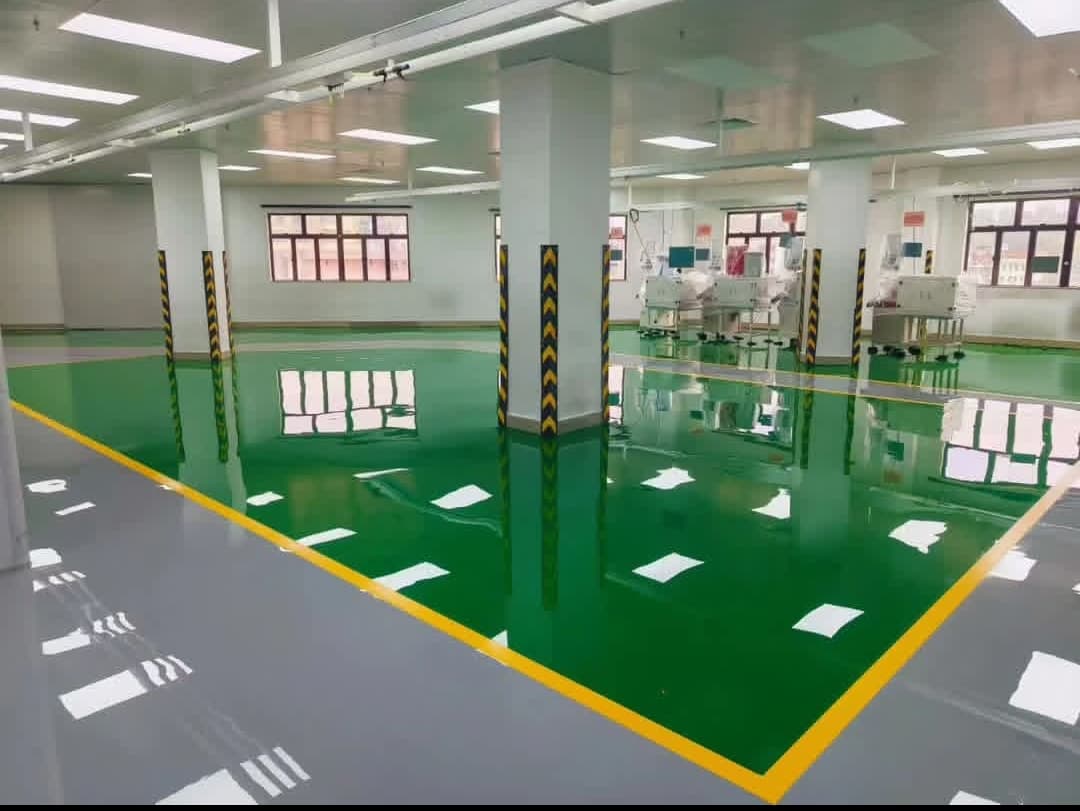
Industrial Epoxy Flooring — Frequently Asked Questions
Can you install an industrial epoxy floor without shutting down the factory?
Usually yes. We phase the work bay by bay, or work nights and weekends, so that part of your plant stays operational. Phasing adds to the cost because each section needs its own set-up and edge detail, but it is far cheaper than losing a week of production.
Will epoxy stick to an old, oil-stained concrete floor?
Not to the oil. Oil-contaminated concrete has to be degreased and then mechanically ground back, and badly soaked patches are cut out and replaced with epoxy mortar. Skipping this is the single most common cause of a floor peeling within months.
How thick should an industrial epoxy floor be?
For light traffic and general storage, a 300 to 500 micron roller-applied system is enough. For forklift traffic and impact, we specify 1mm to 5mm of self-levelling epoxy. We recommend a thickness after inspecting the slab and understanding the loads it carries.
Is the floor slippery when wet?
A plain gloss epoxy is slippery when wet, which is why we broadcast an anti-slip aggregate into the top coat in washdown areas, ramps and loading bays. You choose the level of texture — from a light grip to an aggressive non-slip finish.
How long before forklifts can use the floor?
Foot traffic after about 24 hours, light wheeled traffic after 72 hours, and full forklift and racking loads after seven days. Epoxy gains chemical resistance and hardness over that full cure period.
Do you work outside Abeokuta and Ogun State?
Yes. We are based at Apete, Obantoko in Abeokuta and regularly install floors in Lagos, Ibadan and across Nigeria. For sites outside Ogun State we include travel and accommodation in the quote up front, so there are no surprises.
Materials and related services
We also supply the chemicals used on this system — epoxy primer for concrete floors and epoxy floor paint — to contractors and self-builders anywhere in Nigeria.
What this system costs per square metre, and what moves a quote to either end of the range, is set out in our 2026 price guide to epoxy flooring in Nigeria.
- Residential Epoxy FlooringDurable, attractive, and easy-to-maintain epoxy flooring solutions for homes, garages, and living spaces.
- Commercial Epoxy FlooringProfessional flooring systems for offices, retail outlets, showrooms, hospitals, and public facilities.
- 3D Epoxy FlooringDecorative flooring solutions featuring stunning three-dimensional designs and premium glossy finishes.
Ready to start your industrial epoxy flooring project?
Tell us the size and location of your site and we will come back with a written, itemised quote — no upfront payment required.
Request a free quote