
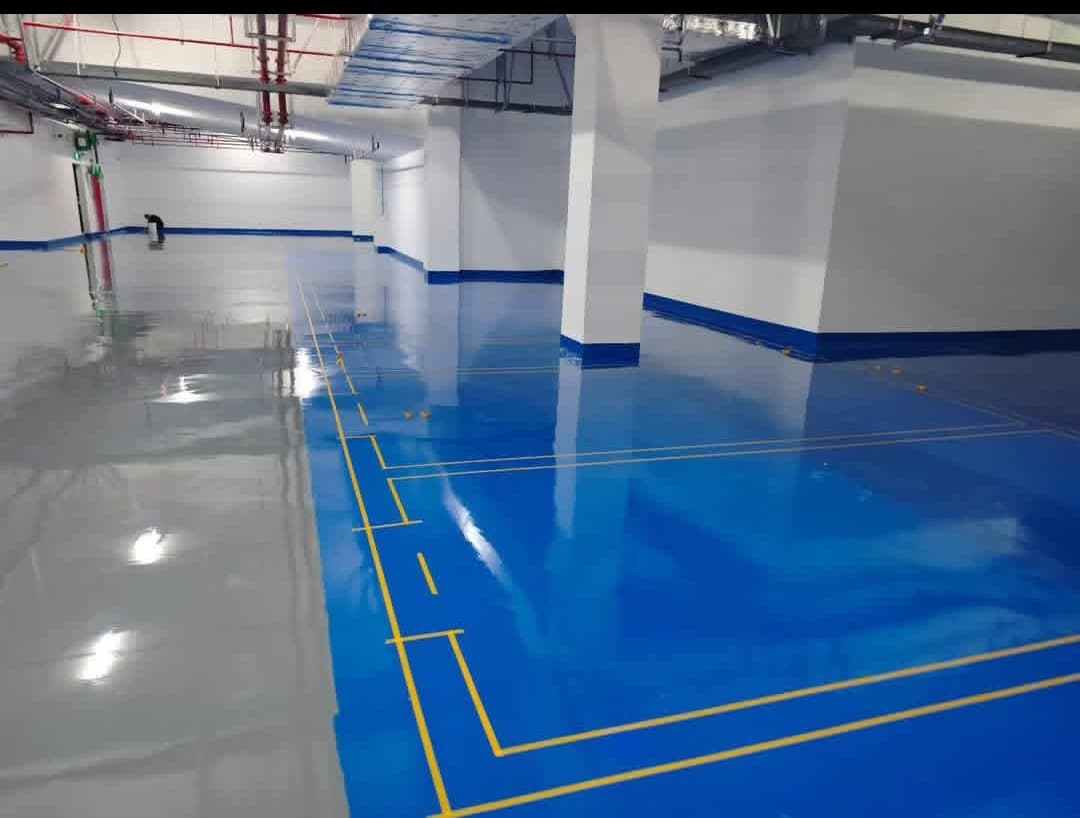
Commercial Epoxy Flooring in Abeokuta & Nigeria
Commercial floors sit between two demands: they have to look presentable to customers and they have to survive hundreds of people walking across them every day. Vinyl scuffs and lifts at the seams, tiles crack under trolley wheels, and carpet in a Nigerian showroom is a maintenance liability.
ABA Eagle Enterprise installs commercial epoxy flooring for offices, banking halls, showrooms, retail outlets, hospitals and clinics, laboratories, schools and places of worship in Abeokuta, Ogun State and across Nigeria. The result is a seamless floor that cleans in one pass and holds its finish under constant footfall.
Request a free quoteWhere commercial epoxy earns its keep
- Showrooms and retail floors — a mirror-gloss surface that makes stock look better under lighting
- Hospitals, clinics and laboratories — seamless and coved to the wall, so there are no joints harbouring bacteria
- Offices and banking halls — quiet, hard-wearing, and refreshed with a top coat instead of a refit
- Schools and lecture halls — survives constant footfall and dragged furniture
- Restaurants and commercial kitchens — grease resistant, washable, with anti-slip texture where it is wet
- Car showrooms and service receptions — takes vehicle weight without marking
Installing around your trading hours
Very few commercial clients can close for a week, so scheduling is part of the specification rather than an afterthought. We routinely work nights, weekends and public holidays, and we phase larger floors so that a section is always open to the public.
Where you cannot afford a seven-day cure before heavy use, we specify a fast-cure system that takes light foot traffic overnight. It costs more per square metre and we will only recommend it where the downtime saving genuinely justifies the difference.
Hygiene, safety and compliance
For healthcare and food service clients, the floor is part of the hygiene regime. A seamless epoxy floor with coved skirting has no joint between floor and wall, so there is no line of grout or silicone to trap organic matter. Surfaces can be washed down with standard disinfectants without degrading.
On safety, we match the anti-slip level to the area rather than applying one texture everywhere: a smooth gloss in a dry showroom, a light grip in a corridor, and an aggressive texture in a kitchen or washroom. We also handle line marking, walkway demarcation and colour-coded zoning as part of the same installation.
Taking up what is already on the floor
An industrial job usually starts with bare concrete. A commercial one almost never does, and whatever is already down is what sets the preparation cost. This is the stage clients are most often surprised by, so we itemise it separately in the quote rather than folding it into a rate per square metre.
- Vinyl sheet and tiles — the covering lifts easily; the adhesive underneath does not. Residual adhesive has to be scraped and then ground off completely, because epoxy applied over even a thin smear of it cisses into fisheyes and never bonds.
- Ceramic and porcelain tiles — sound, well-bonded tiles can be ground and coated over. Where a significant proportion sound hollow, breaking out and screeding is the honest answer, and we say so at survey rather than after the tiles start moving.
- Terrazzo and polished screed — usually an excellent substrate. Grinding off the polish is all that is needed to give the primer something to key into.
- Carpet and underlay — the grip rods, staples and latex residue all have to come out, and the latex is the slowest part.
- Painted concrete — old floor paint is ground back entirely. A new system over an old paint film is only as well stuck as the paint under it.
Coating thickness for a public-facing floor
Commercial floors carry footfall and trolley wheels rather than forklifts, so the driver is appearance and cleanability rather than raw load capacity. That usually points to a thinner build than an industrial specification, with the money spent on flatness and finish instead.
- Offices, banking halls and lecture rooms, 300 to 500 microns — roller-applied, and refreshed with a top coat rather than replaced.
- Showrooms, retail floors and receptions, 1 to 2mm self-levelling — the flatness is what produces the mirror reflection a rolled film cannot.
- Hospitals, laboratories and commercial kitchens, 2 to 3mm self-levelling with coving carried up the wall — the coved junction is the point of the specification, not an extra.
- Coving is priced per linear metre of wall, separately from the floor area, and is formed to a radius at the floor-to-wall junction so a mop reaches into it.
Curing around trading hours in Nigerian conditions
The whole commercial specification is a negotiation with your opening time, and Nigerian ambient temperature works both for and against you. Heat brings a film hard faster, which is what makes overnight working possible at all. It also shortens pot life sharply — every 10°C above the datasheet temperature roughly halves the time between mixing and the point where the material stops flowing. A hot afternoon pour in a glazed showroom sets before it has levelled and leaves visible squeegee lines in exactly the floor whose finish you are paying for.
Working at night is therefore not only about your trading hours. An Abeokuta showroom at 2am sits several degrees below its afternoon temperature, the material flows properly, and the floor is walkable by opening. On a standard system at these temperatures, expect light foot traffic from about 24 hours, and full cleaning regimes, trolley traffic and furniture from seven days. A fast-cure specification brings foot traffic down to roughly 12 hours, at a higher rate per square metre.
The constraint we will not move on is disinfectant and wet cleaning. In hospitals and kitchens the cleaning team often starts the moment a space reopens, and a floor washed with strong disinfectant before it has reached full chemical cure will soften and mark permanently. We hand over a written date for the start of full wet cleaning and we do not shorten it.
During the rains, a cool slab and humid air can condense moisture into the curing film and leave amine blush — a hazy, greasy surface layer the next coat will not bond to. We wash and abrade any blushed layer before recoating rather than trusting it to stick.
How commercial floors fail, and how we avoid it
- Fisheyes and craters across a showroom floor — traces of old vinyl adhesive, floor polish or silicone left in the substrate. Avoided by grinding the substrate back fully rather than chemically stripping it.
- Cracking at the floor-to-wall junction in a hospital or kitchen — coving formed too thin or without a proper fillet cracks at the corner and reopens exactly the joint the specification was meant to eliminate.
- Permanent marking from early disinfection — the floor cleaned aggressively on day one of reopening, before the film has reached chemical cure.
- Squeegee and roller lines in a gloss finish — the visible result of a self-levelling coat mixed in batches too large for the ambient temperature.
- Wear tracks at entrances within a year — grit walked in from outside acts as an abrasive. Avoided with entrance matting, which does more for a commercial floor than any upgrade to the coating.
- Delamination along a phase joint — where a floor is installed in sections across several nights, a badly detailed edge between phases becomes the line the floor eventually lifts along.
Cost factors and lifespan
Commercial quotes are priced per square metre in Naira after an out-of-hours survey. Two things move a commercial figure that barely register on an industrial one: the removal of whatever is already down, and the cost of working while you are closed. Neither is a percentage adjustment — both are separate lines, and we itemise them so you can see what the choice of working window is actually buying you.
The rest follows the specification: a self-levelling showroom floor uses several times the material of a rolled office coating, coving is charged by the linear metre of wall, and fast-cure chemistry carries a premium we will only recommend where the downtime it saves genuinely justifies it. Distance from Abeokuta and crew accommodation are stated up front for sites outside Ogun State.
In a busy retail or hospital environment, expect eight to twelve years from the system with a refresh top coat somewhere in the middle. In an office with lighter traffic, considerably longer. Either way the recoat is a one-night job, not a refit.
Commercial Epoxy Flooring — Frequently Asked Questions
Can you install the floor overnight so we can trade in the morning?
With a fast-cure system, yes — light foot traffic is possible after around 12 hours. Standard epoxy needs 24 hours before foot traffic. We agree the system based on how much downtime you can actually afford.
Do we need to remove the existing vinyl or tiles first?
Vinyl and its adhesive have to come up; epoxy will not bond reliably through them. Sound tiles can often be ground and coated over. We confirm which applies at the survey, and the removal cost is itemised separately in the quote.
Is epoxy suitable for a hospital or laboratory floor?
It is one of the standard specifications for both. The floor is seamless, non-porous and can be coved up the wall so there is no floor-to-wall joint, and it tolerates routine disinfection.
Can you match our brand colours?
Yes. We tint to your brand colours and can inlay logos, zone markings and directional lines into the floor rather than painting them on top, so they wear at the same rate as the rest of the surface.
If you install our floor over several nights, will the joins show?
Not if the phase edges are planned before we start. We set each night’s stopping line at a natural break — a doorway, a column line, a change of colour — rather than wherever the crew happens to run out of time, and that edge is ground back and re-primed before the next section butts into it. An unplanned wet edge left to harden mid-floor is both visible and the line a floor eventually delaminates along.
What maintenance does a commercial floor need?
Daily dust mopping and periodic wet cleaning with a neutral detergent. Entrance matting to catch grit is the single most effective thing you can do — most wear on a commercial floor is sand walked in from outside.
Materials and related services
We also supply the chemicals used on this system — epoxy floor paint and epoxy primer — to contractors and self-builders anywhere in Nigeria.
What this system costs per square metre, and what moves a quote to either end of the range, is set out in our 2026 price guide to epoxy flooring in Nigeria.
- Industrial Epoxy FlooringHeavy-duty flooring systems designed for factories, warehouses, workshops, and high-traffic industrial facilities.
- Residential Epoxy FlooringDurable, attractive, and easy-to-maintain epoxy flooring solutions for homes, garages, and living spaces.
- 3D Epoxy FlooringDecorative flooring solutions featuring stunning three-dimensional designs and premium glossy finishes.
Ready to start your commercial epoxy flooring project?
Tell us the size and location of your site and we will come back with a written, itemised quote — no upfront payment required.
Request a free quote