
Cost of Epoxy Flooring in Nigeria (2026 Price Guide)

Published 11 min read
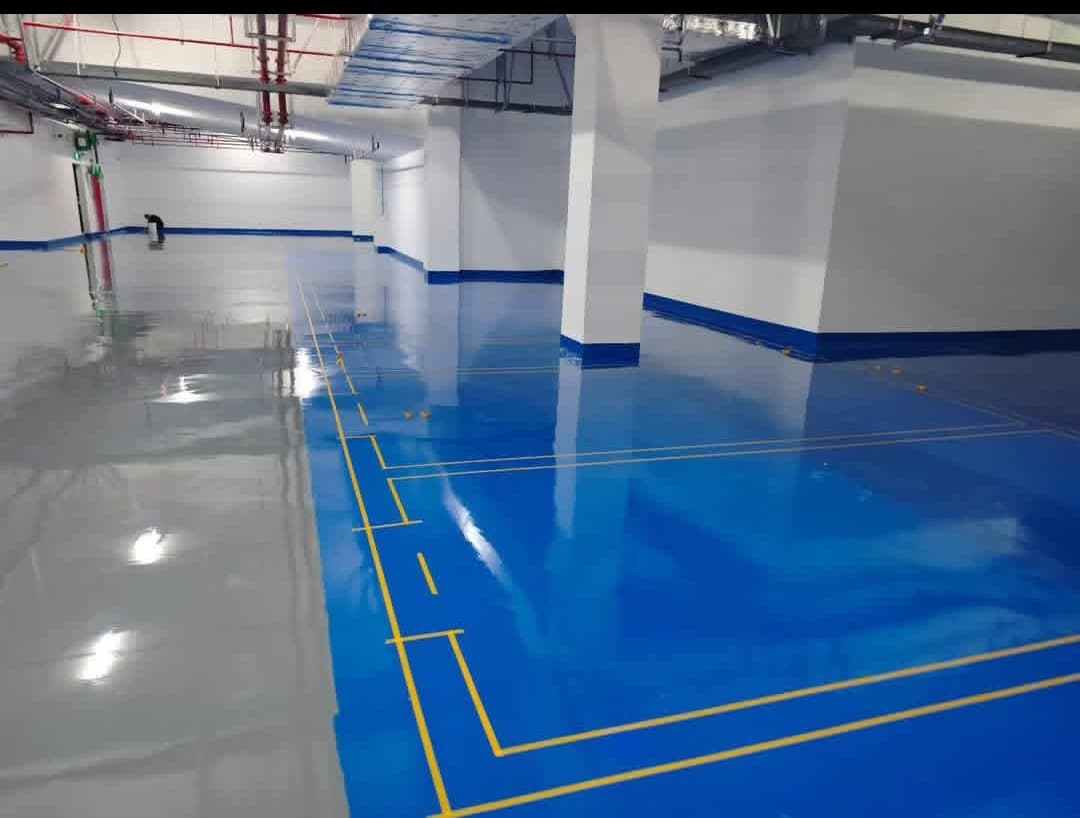
Epoxy flooring in Nigeria is quoted per square metre, with material and labour together. These are the rates we install at, from Abeokuta to sites anywhere in the country. Everything below the table explains what moves a job to the top or the bottom of each range.
| System | Typically used for | Rate per m² | Same rate per sq ft |
|---|---|---|---|
| Metallic self-levelling (1.0mm, 1.5mm or 2mm thickness) | Homes, offices, shops, showrooms, pharmacies, light industrial units | ₦18,000 – ₦30,000 | ₦1,670 – ₦2,790 |
| Epoxy mortar + self-levelling (5mm, heavy duty) | Warehouses, factories and workshops with forklift and pallet-truck traffic | ₦30,000 – ₦35,000 | ₦2,790 – ₦3,250 |
| 3D graphics epoxy floor | Feature floors in homes, hotels and showrooms | ₦35,000 | ₦3,250 |
| 3D graphics epoxy swimming pool | Pool shells, domestic and hotel | ₦35,000 | ₦3,250 |
| 3D epoxy wall mural | Feature walls and reception areas | ₦18,000 | ₦1,670 |
We quote in square metres. The sq ft column is the same rate converted, not a second price list — a square metre is about 10.8 sq ft. Every rate depends on the condition of the floor we are covering, the total area, and where the site is. We publish ranges because those variables are real. The rest of this guide is about which end of the range your floor sits at.
Epoxy flooring price per square meter in Nigeria: what the rate covers
The rate is not the coating alone. It covers moisture and soundness testing, mechanical preparation by diamond grinding or shot blasting, crack and joint repair, a two-component penetrating primer, the build coats at the specified thickness, and the top coat. On a floor in poor condition, preparation takes more days than the coating.
Two contractors can therefore quote the same epoxy and arrive at very different numbers, because one has priced the grinding and the repairs and the other has not. Our industrial epoxy flooring and residential epoxy flooring pages set out the full sequence step by step.
Every floor uses the same three systems
Most buyers assume an industrial floor is a fundamentally different, costlier product from a residential one. It is not. Residential, warehouse, factory, pharmacy, showroom, shop — the process is the same, and there are only three systems:
- Self-levelling coat at 1.0mm, 1.5mm or 2mm thickness — the system behind most floors we install, in homes and factories alike
- Mortar plus self-levelling at 5mm — the heavy-duty build, for forklift traffic, point loads and impact
- 3D graphics — a printed image sealed under clear resin, on floors, pool shells and walls
The building decides which system it needs, not which price list it belongs to. A pharmacy with trolley traffic and a family sitting room take the same 2mm self-levelling floor at the same rate. A warehouse with loaded forklifts needs the 5mm mortar build, and that costs more because it is five millimetres of material and an extra day of work — not because the word "industrial" is on the quote. The same goes for a commercial epoxy floor in a shop or showroom.
Small jobs cost more per square metre, not less
This one is counterintuitive to nearly everyone we quote. Buyers expect bulk pricing to work the way it does in a shop, where a bigger order means a lower unit price and a small order costs less overall. On a floor, the direction reverses at the unit level:
- 1,000 m² and above — the rate per m² comes down
- 10 m² to 500 m² — the rate per m² is higher
Most of the cost of a small floor is not the epoxy. Getting the grinder, the shot blaster, the mixing equipment and the crew to site costs the same whether the room is 15 m² or 150 m², and the floor still has to be tested, ground, repaired, primed, coated and topped either way. Material comes in fixed batch sizes a small room cannot finish. Spread that over 15 m² and the rate is high; over 1,200 m² it nearly disappears.
So a small room is cheaper in total and dearer per square metre. If you are comparing our rate against a price you saw quoted for a 2,000 m² warehouse, you are not comparing the same thing.
What pushes a quote to the top or the bottom of the range
Surface preparation is almost always the largest variable, and it is the one you cannot see in a photograph of a finished floor.
- Slab condition — a sound, dry slab needs grinding and priming; an oil-contaminated, dusting or cracked one needs cutting out, filling and levelling first.
- Rising damp — a ground-floor slab with no damp-proof membrane needs a damp-tolerant primer or a membrane, or the floor blisters. We moisture-test before quoting.
- Existing finishes — tiles, old paint or a failed coating have to come off, and removal is labour we price.
- Thickness and area — 1.0mm, 1.5mm and 2mm thickness are three different quantities of material, and the volume effect applies on top.
- Location — sites outside Ogun State carry transport and crew accommodation, stated up front rather than buried in the rate.
How to recognise a quote too cheap to be real
We have been called in to strip and redo floors laid by someone cheaper more times than we would like, and the pattern is consistent enough to spot in the quote:
- No moisture or soundness test before a price — nobody can price preparation without knowing what is under the floor.
- Acid etching instead of mechanical grinding. Cheaper, faster, and it leaves salts behind that cause peeling.
- No primer in the specification. Primer locks down dust and gives the build coats something to bond to.
- A solvent-thinned coating sold as 100% solids epoxy. It shrinks back as it cures, so the film is thinner than the one you paid for.
- One day quoted for grind, prime, build and top coat on a floor that needs cure time between layers.
A floor that fails costs the original price, plus removal, plus the correct installation. The gap between a real quote and a cheap one is almost always smaller than that.
3D epoxy floor price in Nigeria
A 3D epoxy floor is ₦35,000 per m², and a 3D epoxy swimming pool is the same ₦35,000 per m². 3D epoxy wall murals are ₦18,000 per m².
The rate is flat because the work is predictable: a dead-flat cured base, the print bedded down without air pockets, then clear resin over it. What varies is time, not price. A 3D room runs seven to ten days because every layer must cure before the next, and the clear pour cannot be rushed — a thickened clear layer traps its own air, and those bubbles cure permanently into resin sitting over an image nobody can reach again.
Epoxy product prices — buying material only
We supply chemicals to contractors and self-builders nationwide, separately from installation.
| Product | Unit | Price |
|---|---|---|
| Epoxy paint | Drum — 18kg paint + 3.6kg curing agent | ₦150,000 |
| Epoxy resin | Per kg | ₦9,000 |
| Epoxy primer part 1 | Per kg | ₦10,000 |
| Epoxy primer part 2 | Per kg | ₦10,000 |
| Epoxy hardener | Per kg | ₦12,500 |
| Epoxy anti-scratch | Per package | ₦150,000 |
These are material prices, not installed rates — do not add them to the per-square-metre figures at the top, which already include material. Product pages and current stock are at epoxy floor paint, epoxy resin, epoxy hardener and epoxy primer parts 1 and 2.
How much epoxy do I need?
For paint and primer we can give you coverage, because both behave predictably.
| Film thickness | Coverage |
|---|---|
| 1.0mm thickness | 15 m² (about 161 sq ft) |
| 1.5mm thickness | 13 m² (about 140 sq ft) |
| 2mm thickness | 10 m² (about 108 sq ft) |
Epoxy primer parts 1 and 2, 36kg in total, cover 80 to 100 m² (roughly 860 to 1,080 sq ft) depending on how porous and how sound the floor is. A tight power-floated slab sits at the top of that; an open, dusty one drinks more.
Worked through: a 92.9 m² floor (1,000 sq ft) at 1.0mm needs seven drums of paint, since one drum covers 15 m². The same floor at 2.0mm needs ten, because coverage drops to 10 m² per drum. Primer for that floor is one 36kg set. At ₦10,000 per kg for each part, a 36kg set works out at ₦360,000, and seven drums of paint at ₦150,000 each is ₦1,050,000 — before you have paid anyone to grind, prime or lay it.
Why we don’t publish coverage per kg for resin and hardener
We are asked this every week and we deliberately do not answer it with a number, because any single figure would be wrong for most of the people reading it.
Coverage there depends almost entirely on the substrate. Over glazed tiles, which absorb nothing, a kilogram goes several times further than over bare concrete — three to four square metres on tiles against under one on a raw, porous floor. Publish the tile figure and half our customers run out mid-floor; publish the concrete figure and the other half over-order.
So we ask what you are coating, how it has been prepared and what thickness you are building to, then tell you what to buy. Paint and primer are different: their coverage is stable enough to publish, which is why the figures above are there.
Epoxy flooring vs tiles cost over ten years
Tiles win on day one and lose over a decade. Grout darkens, washes out and has to be redone; individual tiles crack under impact and lift under trolley and forklift wheels, and a replacement rarely matches its neighbours. An epoxy floor is seamless — no grout to fail, no tile to lift — and when the surface dulls it is abraded and recoated rather than removed.
That holds for industrial, commercial and wet areas without qualification. For a small domestic bathroom, tiles are often still the more practical choice, and we will say so.
Curing and downtime at Nigerian temperatures
Epoxy datasheets are written for a laboratory at 20 to 25°C. On a slab in Abeokuta at 28 to 34°C the first number to change is not cure time but pot life: every 10°C rise roughly halves the working time between mixing and the point where the material stops flowing. Forty minutes on the datasheet can be twenty on the slab. We mix small and pour early — an afternoon pour in a closed-up room sets before it has levelled and leaves squeegee lines in the finish you are paying for.
During the rains, a cool slab and humid air condense moisture into the curing film and leave amine blush, a hazy greasy layer the next coat will not bond to; we wash and abrade it off rather than hope. In harmattan the problem reverses — airborne dust settles into a wet film and cannot be taken out afterwards, so we screen the area and coat in the calmer part of the day.
For planning: light foot traffic at about 24 hours, light wheeled traffic at 72 hours, and full forklift and racking loads at seven days. Pool shells are filled only after the seven-day cure, and we hand over a written fill date that we do not shorten.
All prices here were accurate at publication in August 2026 and are quoted as ranges because floor condition, total area and location genuinely move them. A final figure comes from a site visit and a written, itemised quote.